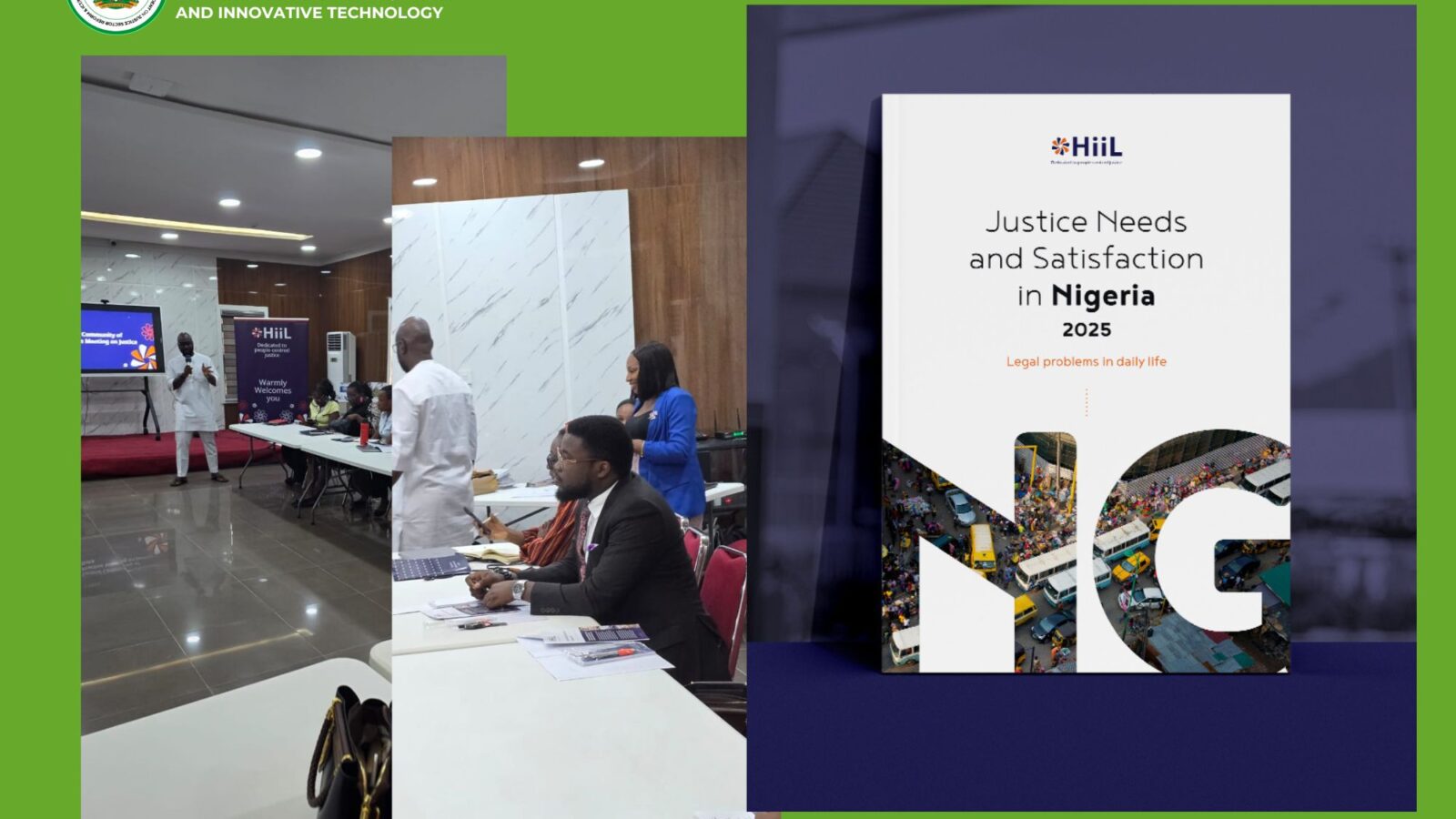
There is a narrative about access to justice in Nigeria that has shaped policy conversations for decades: the people most excluded from justice are in rural areas, far from courts, lawyers, and any institutional mechanism for resolving disputes. The HiiL Justice Needs and Satisfaction Survey for Nigeria 2025 tells a different story.
Yesterday, I participated in the Second Community of Practice (CoP) Meeting on the Justice Needs and Satisfaction Survey for Nigeria, convened under the Hague Institute for Innovation of Law (HiiL). As a member of the Nigerian National Core Convening Group and the Reference Group of Experts for this survey, I joined fellow stakeholders to review the 2025 findings, draw lessons from the data, and begin thinking through what justice projects should be designed and prioritised in response.
The finding that generated the most discussion was this: the Nigerians with the least access to justice are older, poorer people living in urban areas, not those in rural communities as has long been assumed.
Why This Result May Not Be Surprising
At first glance, the finding seems counterintuitive. But when set against recent developments in Nigeria’s justice sector, there is a plausible explanation.
Over the last several years, deliberate attention has been paid to improving access to justice in rural Nigeria. Traditional rulers and other informal actors have been progressively embraced within the broader justice delivery framework, recognised not as obstacles to formal justice but as important entry points into it. Legal aid and community justice initiatives have increasingly been oriented toward rural populations. State-level reforms in places like Imo, Ogun, and Kaduna have targeted rural justice needs specifically.
Beyond these deliberate interventions, villages across Nigeria already have longstanding dispute resolution structures. Family and clan-based mechanisms embedded in community life have absorbed and resolved conflicts for generations. These informal systems are familiar, accessible, and trusted. They do not require money, transport, or knowledge of formal procedure. For many rural Nigerians, they represent a functional, if imperfect, first response to legal problems.
Urban poor communities, particularly older and economically vulnerable residents in our cities, often have neither. They have moved away from or do not belong to the community networks that provide informal justice in village settings. At the same time, they face significant barriers to formal institutions: cost, distance within cities, limited legal awareness, and a justice system that has not been designed with them in mind. The data suggests it is in this space that the most acute unmet justice need now sits.
This is a useful reminder that access to justice interventions can work, and that their success in one area can shift where the greatest need is found.
What the Survey Found
The 2025 report is part of a longitudinal study that has tracked the same group of respondents since 2023, monitoring how their legal problems evolve over time rather than capturing a single snapshot. The findings across the survey waves are instructive:
- Approximately 81% of Nigerians experienced at least one legal problem in the past year, with many facing multiple problems at the same time.
- The most serious legal problems include land disputes, domestic violence, and neighbour disputes.
- Only 5% of people with legal problems turn to a lawyer. Most rely on family, friends, police, community leaders, and religious authorities.
- Over half of legal problems from the prior survey wave were eventually resolved, but the most serious ongoing problems continue to have significant negative effects on people’s health, livelihoods, and relationships.
- People who experienced a legal problem in the first survey wave are slightly more likely to encounter new legal problems in the following year, suggesting that unresolved justice needs tend to accumulate.
Implications for Reform
The data raises several considerations for the reform agenda.
Legal aid and access-to-justice programmes need to account for the urban poor. Geographic distance from formal institutions is clearly not the only barrier. For older and poorer urban residents, cost, distrust, limited awareness, and the absence of community support structures all present obstacles that programme design must address directly.
The low rate of lawyer engagement reflects barriers that the profession needs to take seriously. When only 5 in every 100 people with legal problems seek a lawyer, it is worth examining what is keeping people away, and whether the way legal services are structured and delivered is suited to the population that most needs them.
The relative success of informal rural justice mechanisms deserves recognition and further study. Rather than treating informal dispute resolution as a gap to be filled by formal institutions, reform efforts should look carefully at what makes these mechanisms work and how their reach and quality can be supported and extended.
Longitudinal data of this quality should directly inform budgeting and legislative priorities. The HiiL survey provides one of the most rigorous empirical bases available for justice sector planning in Nigeria. It should be used as a reference point in reform bills, policy documents, and outcome monitoring, not simply noted and set aside.
Looking Forward
At yesterday’s CoP meeting, we moved from analysis to planning, identifying what justice projects the data supports and mapping out what collaboration between government, civil society, and the legal profession needs to look like going forward.
The full 2025 report, along with the 2023 and 2024 reports that preceded it, is available for download at: https://www.hiil.org/research/justice-needs-and-satisfaction-in-nigeria/
Every stakeholder in Nigeria’s justice sector, including lawyers, judges, policymakers, civil society organisations, and development partners, would benefit from reading it.