A survey I facilitated last year has confirmed what many of us already feared, and the data is damning.
Last year, I facilitated a survey for SPA Ajibade & Co.’s 18th Annual Business Luncheon on a theme that was both timely and urgent: Rebuilding Public Trust in the Nigerian Justice System: Responsibilities of the Bar, the Bench, and the Society.
I expected sobering findings. What we got was a mirror held up to an institution in freefall.
What We Did
Between November and December 2025, we gathered responses from **446 participants** across all six geopolitical zones of Nigeria, including private practice lawyers, in-house counsel, government legal officers, judicial officers, academics, civil society representatives, and private citizens. The breadth was intentional. We needed to know if the crisis was a professional complaint or a national one.
It is a national one.
The Headline Numbers
Let these sink in:
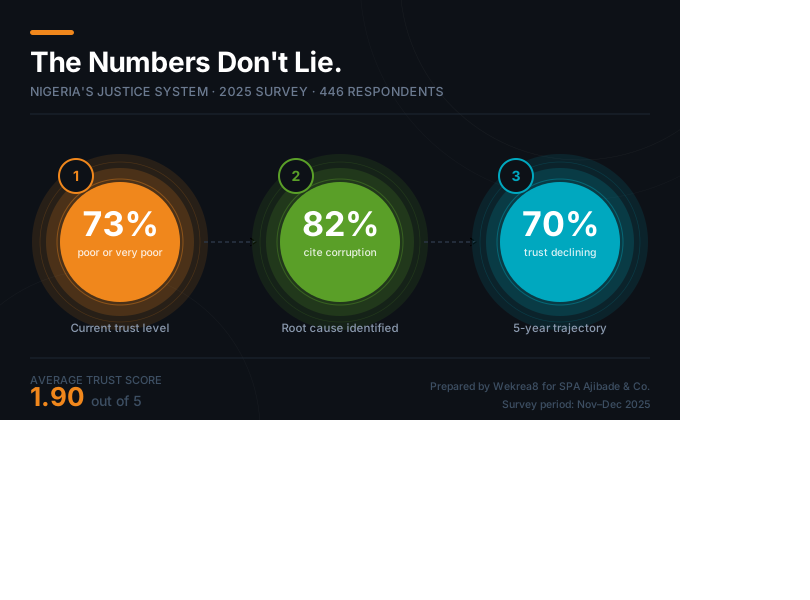
– 73.1% of respondents rated public trust in the Nigerian justice system as poor or very poor
– The average trust score was 1.90 out of 5
– 69.8% believe trust has declined over the last five years
– 81.8% identified perceived corruption as a top cause of trust erosion
– More than 80% cited delays as a major problem
– Over 62% have personally experienced or witnessed an incident that shook their confidence in the system
These are not the grievances of disgruntled outsiders. Judicial officers themselves, the people sitting on the bench, rated public trust at 88.9% poor or very poor. When insiders are that candid, something serious is broken.
The Three Wounds
The survey identified what I’ll call the Trust Erosion Triangle: corruption, delay, and political interference.
Perceived corruption ranked first, selected by over 4 in 5 respondents. The language in the open-ended responses was raw. Phrases like “justice for sale in the open market” and “judiciary in the pocket of the executive” appeared repeatedly. These weren’t academic observations. They were lived experiences.
Delays in justice delivery came second. Cases sitting in court for 6, 7, even 10 years. Judgments delivered orally but not reduced to writing for two years. Final addresses awaiting adoption for over a year. The sentiment “justice delayed is justice denied” showed up in these responses as lived reality, backed by specific cases people named and described.
Political interference ranked third, with 54.5% citing it as a top factor. The 2023 election petitions were mentioned again and again as a watershed moment that crystallised for many the extent of executive capture of judicial decision-making.
The Bench: Rated Below 3/5 Across the Board
We asked respondents to rate the judiciary’s performance across seven areas. Every single metric fell below 3.0 out of 5. The worst were:
– Independence from political influence: 1.79/5, the lowest score of any metric in the entire survey
– Timeliness in delivering judgments: 2.13/5
– Transparency in judicial processes: 2.22/5
The only relative bright spot was accessibility to litigants at 2.67, meaning courts are physically reachable, even if what happens inside them falls far short.
The Bar: Marginally Better, But Not Off the Hook
The legal profession rated slightly higher than the judiciary, but “slightly better than poor” is not a compliment.
Respondents were blunt: the Bar has failed to act as a moral compass, professional regulator, and public advocate. Lawyers who enable delay, file frivolous applications, collude with judges, or act as intermediaries for corruption were called out explicitly. The NBA’s disciplinary mechanisms were described as toothless. The Body of Benchers as egregious failures.
The most telling moment in the qualitative data was the voices of young lawyers, people just entering the profession, expressing shame, disillusionment, and lost passion. One respondent wrote:
“In less than 5 years as a legal practitioner, I have totally lost confidence in the judicial system… I do this job merely as a means to survive. I have lost the zeal I once had for the legal profession.”
Read that again. A lawyer, still practising, describing the work as mere survival. That quote sat with me long after I read it.
What People Want
Here is where the survey offers some hope. The same respondents who delivered blistering critiques also expressed a strong appetite for reform, and remarkable consensus on what needs to happen.
The top reform priorities were:
1. Strengthening anti-corruption mechanisms at 72.2%
2. Comprehensive judicial reform at 63.9%
3. Stricter enforcement of professional conduct rules at 57.8%
4. Automation and digitalisation of court processes at 52.5%
5. Enhanced protection for judicial independence at 49.3%
Across every demographic group, private citizens, senior lawyers, corporate counsel, and judicial officers, the top three priorities were identical. Consensus that clean, across groups that rarely agree, amounts to a clear mandate.
The Stakes Are Bigger Than the Courts
A broken justice system carries consequences far beyond the courtroom: democratic, economic, and social.
When courts cannot be trusted to enforce contracts, investment flees. When election petitions are decided in ways that defy credibility, democracy hollows out. When citizens choose self-help over legal recourse, and this survey shows many already have, the social contract begins to tear.
One respondent captured the trajectory with painful clarity:
“Citizens will rather sort themselves than go to court, because the court has become a toothless bulldog.”
What Must Happen
The survey is emphatic: this cannot be fixed by speeches, committees, or cosmetic adjustments. It requires structural reform. Judicial independence that is real, not rhetorical. Appointment processes that are transparent and merit-based. Disciplinary mechanisms with actual consequences. Technology that closes the gaps where corruption hides.
Most of all, as one respondent wrote simply: “The public needs to see consequences.”
The evidence is in. The diagnosis is clear. The prescriptions are known.
What remains is the will to act.
The full survey report, including detailed breakdowns by professional group, geographic zone, and years of experience, is attached to this post. It was prepared by Wekrea8 for SPA Ajibade & Co. and covers 446 responses gathered across Nigeria between November and December 2025.
I facilitated this survey and am sharing it because the findings are too important to stay in the shelves.